On the Chautauqua Trail
 At the height of America’s Victorian Era—a time often referred to as the Gilded Age—a magical transformation was underway in northern Michigan. What would become a thriving tourism industry was taking shape, with steamers bringing passengers from the big cities to the picturesque town of Petoskey. The Grand Rapids & Indiana Railroad (GR&I) soon followed and by 1874, three trains a week were pulling into town as travelers sought relaxation and socialization “Up North” along the shores of Little Traverse Bay.
About this same time, a group of Methodist church leaders gathered in Jackson, Michigan, and at the conclusion of their meeting it was decided to establish a summer camp modeled after the independent Chautauqua that had just formed in upstate New York. The movement, which swept over the nation during the late twentieth century, was based on four pillars still relevant today: arts, education, recreation and religion.
Seeing an opportunity to increase ridership, the GR&I donated an idyllic 340-acre waterfront parcel just a stone’s throw north of Petoskey for the establishment of the Bay View Association. By the summer of 1876, the land was cleared and massive tents were raised to house the hundreds of people who traveled here for a week of sermons and lectures. The next year, the landscape was adorned with the first 20 of what would become 440 summer cottages—a dozen defined architectural styles, most bearing whimsical names.
Over time, more than 30 public buildings were erected throughout Bay View including Crouse Memorial Chapel, originally built in 1889 as a grocery store; Evelyn Hall, dedicated on July 24, 1890; John M. Hall Auditorium, opened in 1915 to replace the original 1887 hall; and the 1931 Bay View Library, recognized as one of the largest Chautauqua libraries with more than 9,000 titles.
There are two historic boutique inns open to the public for overnight stays, as well as fine dining on regional cuisine like Michigan salad, morel bisque and planked whitefish. The Bay View Inn opened as the Woodland Avenue House in 1886—previously known as the Howard House and Hotel Roselawn before being christened Bay View Inn in 1935. The Terrace Inn welcomed its first guests in the summer of 1911. Today this charming property boasts 38 guest rooms, along with cozy common areas including its infamous covered front porch.
Seven named walking trails skirt the perimeter of the Bay View campus, where birding is a popular pastime. There is also a self-guided walking tour of the grounds, including more than 20 audio recordings which delve into the history of this state and national historic site.
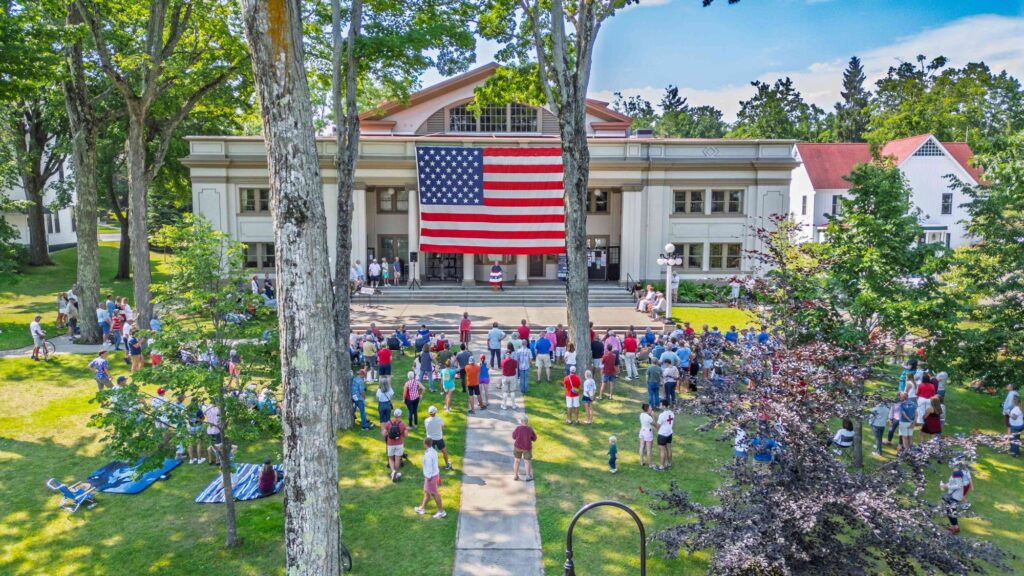
Throughout its short 8-week summer season, Bay View is a lively and lovely place to be, with most activities open to the public and many offered at no charge. On any given day there is a plethora of cultural activities, lectures, workshops, theatrical productions, movies and concerts. There are organized games of pickleball, tennis and shuffleboard, as well as board games, cooking classes and book clubs. Interdenominational programs include guest sermons, bible study classes and Sunday school programs for all ages.
Bay View is one of about 20 Chautauquas currently operating in the United States and Canada, according to the non-profit Chautauqua Network, which maintains a public-facing Chautauqua Trail (ChautauquaTrail.com). As a summer Chautauqua, the Bay View grounds are open May through October only, with the exception of the two inns, which are open year-round.
Did you know?
Over the years, many noteworthy individuals have graced Bay View including Helen Keller, Kate Douglas Wiggin (author of Rebecca of Sunnybrook Farm), Irma Rombauer (author of The Joy of Cooking), Dr. Booker T. Washington, political orator Willing Jennings Bryan and a young, unpublished Ernest Hemingway, to name only a few.
The Chautauqua Trail
Chautauqua is experiencing a renaissance, with each of the 18 communities on the Chautauqua Trail offering enriching programs individual to the site and season. The trail is a non-profit with member spanning locations as diverse as the Mississippi River community of Alton, Ill, Plains, Georgia, and sports in Florida, New York, Colorado and more. Each is committed to supporting development of potential intellectually, spiritually, emotionally and physically, and they’re located in some of North America’s prettiest natural settings.
Learn more: ChautauquaTrail.com