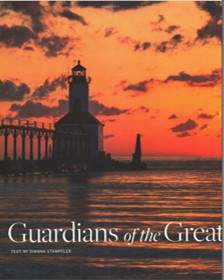
Guardians of the Great Lakes
 The freshwater coastline of the Great Lakes is home to 300 active lighthouses, with Michigan boasting the largest concentration at 129. For more than two centuries, these towering beacons have guided ships through years of mining, lumbering and commercial fishing, along with steamers and recreational vessels transporting tourists from far and wide. Today, dozens of lighthouses open their doors, letting you experience a double treat—the beauty perched on the shoreline and an illuminating look inside the rich maritime history of each. Here are a few worth planning a road trip around.
Lake Michigan
There are only 45 miles of Lake Michigan shoreline in the state of Indiana, and just one historic lighthouse open for tours. Funds were allocated in 1837 for the first light here, followed by the construction in 1858 of the current Michigan City Lighthouse. Deactivated in 1963 it began its restoration under the guidance of the Michigan City Historical Society and opened as a museum in June 1973. The most noted keeper to call this light home was Harriet Colfax, cousin of Schulyer Colfax, the 17th Vice President of the United States, serving under President Ulysses S. Grant during his first term from 1869 to 1873. Harriet dedicated 43 years to this light, at one point also maintained the Michigan City East Pierhead Lighthouse, which you can access by walking the pier in nearby Washington Park on calm days. This Old Lighthouse Museum is open Wednesday to Sunday afternoons from April through October 31. A great souvenir is the illustrated children’s book, Miss Colfax’s Light, available in the museum gift shop.
Fifteen miles north of downtown Chicago, and adjacent to Northwestern University in Evanston, Illinois, the Grosse Point Lighthouse sits within a 16-acre Lighthouse Park District. At the time it was first illuminated on March 1, 1874, Chicago was the busiest port in America and this 113-foot-tall landfall light guided ships traveling from Detroit through the Straits of Mackinac. The Grosse Point Lighthouse was decommissioned by the U.S. Coast Guard in 1941 during World War II, but the second-order Fresnel lens—the largest on the Great Lakes—was relit five years later as a private aid to navigation. In 1976, the lighthouse was added to the National Register of Historic Places and it was designated a National Historic Landmark in 1999. The park grounds around Grosse Point are open year-round, with the Italianate style home-turned-museum and 141 step brick tower accessible on weekends from June through September, weather permitting.
After erosion nearly caused Milwaukee, Wisconsin’s first 1855 North Point Lighthouse to fall into Lake Michigan, a taller 39-foot cast iron, octagon-shaped tower was constructed 100 feet inland. Outfitted with a fourth-order Fresnel lens, it was put into service on the night of January 10, 1888. Georgia Stebbins, who arrived from New York to assist her ailing father with the keeper duties in 1873, later took over the position until her retirement in 1907. Five years after her retirement, the tower was extended to 74 feet (154 feet above Lake Michigan), serving until being decommissioned in 1994. Visitors can tour the handicap-accessible 1888 Queen-Anne-style keeper’s quarters or climb the 84 steps (plus a few rungs of the ladder) to the top of the lantern room for panoramic views of Lake Michigan, every weekend, year-round.
Lake Superior
The 80-mile stretch of Lake Superior between Munising, Michigan and Whitefish Point Light Station in Paradise, is referred to as “The Shipwreck Coast” or “The Graveyard of the Great Lakes.” Over 200 ships have been lost at sea in this region, the oldest being the wooden Invincible, which sank in November 1816. The gales of November also took the lives of all 29 crew aboard the Edmund Fitzgerald in 1975, just 15 miles from the lighthouse. The 200-pound bronze bell from this legendary shipwreck was recovered twenty years later and is on display at the Great Lakes Shipwreck Museum, adjacent to the 1861 lighthouse (which replaced the original 1849 station). The lighthouse campus, which also includes a 1923 U.S. Coast Guard Surfboat House and 1920 restored U.S. Navy Radio Building, is open daily from early May through the end of October. The area is also home to the Whitefish Point Bird Observatory and is considered the “Wild Blueberry Capital of the World.”
Lake Huron
Michigan wasn’t yet a state when the first Fort Gratiot Lighthouse was put into service in 1825 near Port Huron. A newer station was built four years later at the southern end of Lake Huron, near the junction of the St. Clair River, and the tower was heightened in the 1860s to its current 86 feet. Daily tours of the museum complex, which also includes the historic Post Hospital which was relocated to the site, are offered from Memorial Day weekend through mid-September, with weekend tours during the fall season. A special five-hour public paranormal investigation is also held at the lighthouse once a year, typically the Saturday closest to Halloween.
Lake Erie
Marblehead Lighthouse, perched along the rocky Lake Erie coast in Marblehead, Ohio, was built in 1822 and is the oldest continuously operating light on the Great Lakes. In addition to the 49-foot-tall tower (with its 77 spiraling steps), the Marblehead Lighthouse State Park also features an historic keeper’s dwelling, a replica of the 1876 U.S. Lifesaving Station and limestone quarry. The park is open year-round, with the museum buildings open daily, Memorial Day through Labor Day. While in the area, venture three miles south for a docent-led tour of the private home of the light’s first keeper, Benajah Wolcott. After his death in 1832, his wife, Rachel, became the first female keeper on the Great Lakes.
Lake Ontario
Situated on three acres in Cape Vincent, New York—on the eastern coast of Lake Ontario, near the entrance to the St. Lawrence River—the Tibbetts Point Lighthouse was constructed on land once owned by Revolutionary War soldier John Tibbetts. The original 1827 structure was rebuilt in 1854 at which time a French-designed fourth-order Fresnel lens was added to the top of the 59-foot tower—it remains the last functioning lens of its kind on the lake. In the early 1980s, the light was automated and the keeper’s residence transitioned into a youth hostel, operating until 2014. Today, the manicured lighthouse grounds are accessible year-round and the lighthouse atrium and fog horn building are open seasonally based on volunteer availability. The U.S. Coast Guard still maintains the light as an active aid to navigation, meaning the tower is not available to climb.
LIGHTHOUSE TOUR by water
Shepler’s Ferry out of Mackinaw City, Michigan, offers several excursions for viewing offshore lights throughout the Straits of Mackinaw, and beyond. The westbound trip travels into Lake Michigan and includes the ruins of Waugoshance Lighthouse and White Shoal—the tallest lighthouse in the state; eastbound traverses through Lake Huron and includes Poe Reef, Fourteen Foot Shoal and Bois Blanc Island; additional routes extend out to the east as far as the Les Cheneaux Islands, and up the St. Mary’s River toward Sault Ste Marie.
Wisconsin’s Door County peninsula is home to 11 lighthouses, most of which can be seen from the waters of Lake Michigan. Death’s Door Boat Tours takes passengers out to far reaching Plum and Pilot Islands—the latter home to masses of double-crested cormorants and herring gulls as part of the Green Bay National Wildlife Refuge. The oldest light in Door County is the Pottawatomie Lighthouse at Rock Island State Park. A bit of island hopping is necessary to access this 1858 light (built to replace the first 1836 structure). From Northport, take the car ferry to Washington Island and then drive to the northeast side to board a passenger ferry to Jacksons Harbor, followed by a 1.25 mile hike to the lighthouse. Free volunteer-led tours are available daily from Memorial Day weekend through Columbus Day. If time permits, stop by Nelsen’s Hall & Bitters Club on Washington Island. Opened in 1899, it has the distinction as the oldest bar in Wisconsin, surviving prohibition by selling shots of Angostura bitters for “medicinal” purposes.
Bayfield, Wisconsin, is the gateway to the Apostle Islands in southwestern Lake Superior where nine lights remain standing with four currently open for tours. The National Park Service offers seasonal boat trips through these island-laden waters, past towering sandstone cliffs riddled with sea caves formed by centuries of winds and waves. Guided lighthouse tours are available of the 1862 Raspberry Island Lighthouse, 1881 Sand Island Lighthouse and Michigan Island’s 1857 keeper’s residence (excluding the tower) and the modern 1908, 120-foot skeletal tower—both of which require a hike up 123 steps from the dock. The Outer Island Lighthouse is currently closed due to construction and rehabilitation.