Explore History Along Petoskey’s Unique Trail: The Inland Waterway
Michigan has many monikers – like the Great Lakes State. According to the Department of Natural Resources (DNR), it is also known as The Trails State, with thousands of seasonal routes crisscrossing the state – from hiking and biking to paddling and skiing. The scenic trails throughout the Petoskey rAea provide a wealth of recreational opportunities for locals and visitors, while also offering unique historical perspectives – a trip back in time as it were. As you venture along these various routes, be on the lookout for markers, museums and other remnants of days gone by, which are sure to enhance (and educate) your experience.
Long before northern Michigan became a tourist mecca, Native Americans avoided the often-treacherous waters in the Straits of Mackinac by paddling, a series of connecting lakes and rivers today known as the Inland Waterway – the largest such route in the state. More than 50 encampments have been unearthed along this route, including one in Ponshewaing on the north side of Crooked Lake with artifacts dating back over 3,000 years.
This 38-mile water route spans Emmet and Cheboygan counties (including the communities of Conway, Oden, Ponshewaing, Alanson, Indian River, Topinabee and Cheboygan) and consists of Crooked Lake, Crooked River, Burt Lake, Indian River, Mullet Lake and Cheboygan River, before emptying into Lake Huron. With a maintained depth of five feet, the waterway boasts two seasonal locks – one in Cheboygan and one in Alanson, which is also home to the “World’s Shortest Swing bridge” originally built in 1901. Each Labor Day, this town hosts its annual bridge walk led by the Rivertown Jazz Band and including other community activities in Memorial Park. It should be noted that US-31 is under construction in downtown Alanson, so visitors should plan for detours and delays.
Open to both motorized and non-motorized boaters, the Island Waterway invites a leisurely river experience past quaint homes, historic businesses and beautiful natural areas where swans, geese and loons are often seen. The lakes are large enough for water skiing, tubing, wakeboarding, and jet skiing, with several beach areas as well.
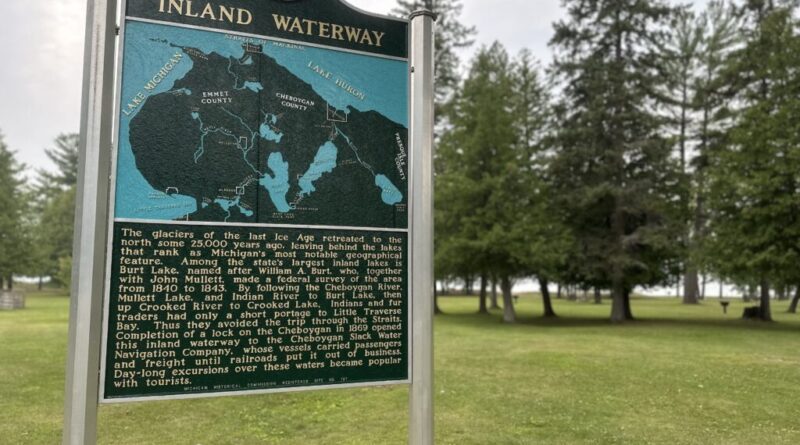
In 1957, the State of Michigan erected the Inland Waterway Historic Marker at Burt Lake State Park (follow the signs to the beach area) in Indian River (Tuscarora Township, Cheboygan County) to recognize the importance of this route to early commerce including fur traders, freight service and day-long passenger excursions. The Inland Water Route Historical Society was formed in 2004 to research and document the history of this route, operating a museum on River Street just one block east of US-31 in downtown Alanson (near the swing bridge). Open seasonally, you can visit the Inland Water Route Historical Museum to see photos, artifacts, and special displays about this intricate connection of water trails.